


Your customers are leaving. And every single one who walks out the door costs you far more than you think.
Here’s the uncomfortable truth most businesses ignore: customer retention statistics consistently show that keeping existing customers is the single most profitable growth strategy available — yet most companies still pour the majority of their budget into chasing new ones. In an era where acquisition costs have surged 60% in five years and consumer trust has hit an eight-year low, the math has never been more clear. The businesses winning right now aren’t the ones spending the most on ads. They’re the ones who refuse to let good customers slip away.
We pulled the most current, verified data from Bain & Company, Harvard Business Review, Salesforce, Zendesk, McKinsey, Forrester, and more. These 15 customer retention statistics tell the full story — from the raw economics of retention to the CX strategies that actually move the needle.
TL;DR — The 5 Statistics That Should Change Your Strategy Today:
- A 5% increase in retention boosts profits by 25–95% (Bain & Company / HBR)
- Acquiring a new customer costs 5–25x more than retaining one (Harvard Business Review)
- 52% of customers will switch to a competitor after a single bad experience (Zendesk)
- The probability of selling to an existing customer is 60–70% vs. just 5–20% for a new prospect (Marketing Metrics)
- Customer acquisition costs have risen ~60% in the last five years (SimplicityDX)
The ROI of Keeping Customers
Retention isn’t a feel-good metric — it’s the most direct lever for profitability most companies never pull hard enough. The data below quantifies exactly what’s at stake when you treat existing customers as an afterthought.
1. A 5% Increase in Retention Boosts Profits by 25–95%
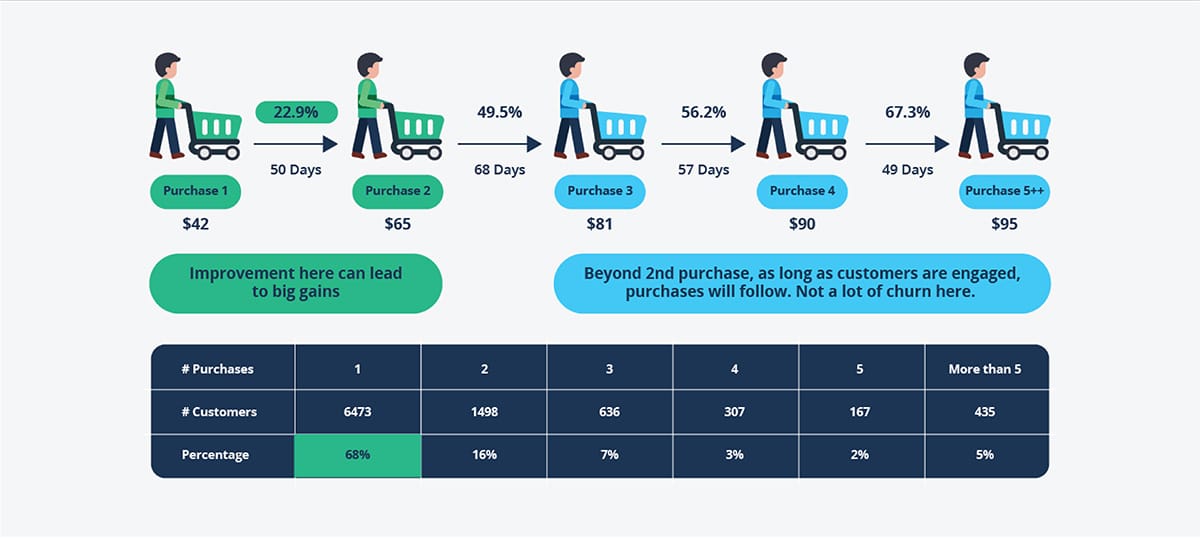
According to Bain & Company research published in Harvard Business Review, a 5% improvement in customer retention rates increases profits by 25% to 95%.
Small retention gains compound into massive profit swings.
This isn’t a rounding error — it’s a multiplier effect. Retained customers cost less to serve, buy more frequently, and refer others. The profit impact compounds over time because you’re building on a base that already trusts you, rather than starting from zero with every new prospect.
2. Acquiring a New Customer Costs 5–25x More Than Retaining One
Harvard Business Review reports that acquiring a new customer costs 5 to 25 times more than retaining an existing one.
Every dollar spent on retention works harder than acquisition spend.
This gap keeps widening. According to SimplicityDX research, customer acquisition costs have risen approximately 60% over the past five years, driven by rising digital ad prices and increased competition. Meanwhile, the cost of a well-executed retention program remains relatively stable. The math increasingly favors keeping who you already have.
3. 65% of Revenue Comes From Existing Customers
Data compiled across Gartner, Invesp, and BIA Advisory Services shows that 65% of a company’s revenue comes from existing customers — rising to 80% for businesses more than five years old.
Your current customers are your revenue engine, not acquisition.
For mature businesses, this number is staggering. If four out of five dollars come from people who already know you, then retention isn’t a department — it’s the business model. Companies that underinvest in retention are effectively neglecting the majority of their revenue base.
4. The Probability of Selling to an Existing Customer Is 60–70%
According to Marketing Metrics by Paul Farris et al., the probability of selling to an existing customer is 60–70%, compared to just 5–20% for a new prospect.
Existing customers are 3–14x more likely to buy than strangers.
This is the clearest possible argument for investing in upsell, cross-sell, and re-engagement strategies. Your existing customer base is already warm — they’ve already said yes once. The sales friction is dramatically lower, which means faster cycles, higher close rates, and better unit economics on every campaign.
5. Customer-Obsessed B2B Organizations See 49% Faster Profit Growth
Forrester Research (2024) found that customer-obsessed B2B organizations report 49% faster profit growth and 51% better customer retention than their non-customer-obsessed peers.
Obsessing over customers isn’t soft — it’s the fastest path to growth.
The catch? Only 3% of companies meet Forrester’s “customer-obsessed” threshold. That means 97% of businesses are leaving faster growth and better retention on the table. It’s not a resource problem — it’s a prioritization problem.
What Drives Customer Loyalty — and What Destroys It
Retention doesn’t happen by accident. It’s built through experience, personalization, and trust — and destroyed by a single bad interaction. These statistics reveal the fragile dynamics of customer loyalty in 2026.
6. 71% of Consumers Switched Brands in the Past Year
Salesforce’s State of the Connected Customer (2022) found that 71% of consumers switched brands at least once in the prior year, citing better deals (66%) and better product quality (58%) as the top reasons.
Nearly three out of four customers are not unconditionally loyal.
This means loyalty is earned on every interaction, not locked in by a contract. If you’re not actively giving customers reasons to stay — through value, experience, and engagement — someone else is giving them reasons to leave. Passive retention is a myth.
7. 52% of Customers Will Switch After a Single Bad Experience
Zendesk’s CX Trends 2025 Report reveals that 52% of customers will switch to a competitor after just one negative experience.
One bad touchpoint is all it takes to lose a customer forever.
This is the zero-tolerance reality of modern CX. There’s no “earning back” a customer who’s already gone. Separately, Zendesk found that companies leading in AI-driven CX (“CX Trendsetters”) achieve 22% higher customer retention rates — suggesting that proactive, tech-enabled service isn’t optional anymore.
8. 80% Say Experience Is as Important as Products
Salesforce’s State of the Connected Customer (2023) reports that 80% of customers say the experience a company provides is as important as its products or services.
Experience now sits at parity with product quality in the customer’s mind.
This fundamentally reshapes where you should invest. A superior product with a mediocre experience loses to a good product with an exceptional experience. The companies dominating retention are the ones treating every touchpoint — from first ad impression to post-purchase follow-up — as a product unto itself.
9. 71% of Consumers Expect Personalized Interactions
McKinsey & Company (2021) found that 71% of consumers expect personalized interactions, and brands delivering personalization are 71% more likely to report improved customer loyalty.
Personalization isn’t a perk — it’s now the minimum expectation.
The kicker: 76% of consumers get frustrated when personalization doesn’t happen, according to the same McKinsey report. This means generic, one-size-fits-all marketing isn’t just underperforming — it’s actively driving customers away. Corroborating this, Zendesk (2025) found that 77% of business leaders now believe deeper personalization leads to increased retention.
10. Consumer Trust Hit an Eight-Year Low in 2024
Salesforce’s State of the AI Connected Customer (2024) reports that 63% of consumers say advances in AI make trust more critical than ever, while consumer trust in companies has fallen to an eight-year low.
Trust is collapsing precisely when it matters most.
As AI becomes embedded in every interaction — from chatbots to personalized recommendations — customers are asking harder questions about data use, transparency, and authenticity. Companies that can’t answer those questions clearly and honestly will lose customers to those that can. Trust is the new competitive moat.
Retention Benchmarks by Industry
Not all industries play the same retention game. Where you sit determines what “good” looks like — and these benchmarks reveal just how wide the gap is between sectors that retain well and those that bleed customers.
11. Retention Rates Range From 84% (Media) to 30% (E-Commerce)
According to Statista data compiled by Shopify (2024), average customer retention rates vary dramatically: Media & Professional Services (84%), Insurance (83%), IT Services (81%), Financial Services (78%), Healthcare (77%), Software (77%), Hospitality (55%), and E-commerce (30%).
Your industry determines the baseline — your execution determines the ceiling.
E-commerce retains fewer than 1 in 3 customers annually, while media companies keep more than 4 in 5. If you’re in a low-retention industry, every percentage point improvement is worth exponentially more. Knowing your benchmark is the first step toward beating it.
12. Repeat Customers Spend 67% More After Three Years
Bain & Company research shows that repeat customers spend 67% more in months 31–36 of a relationship than they did in their first six months.
Customer value doesn’t plateau — it accelerates over time.
This is the compounding effect that makes retention so powerful. Long-tenured customers buy more, buy more often, and cost less to serve. They also become advocates — referring new customers at no acquisition cost. The longer you keep a customer, the more valuable they become on every dimension.
13. B2B SaaS Median Annual Churn Is 3.5–4.7%
Recurly and CustomerGauge (2025) report that the median annual churn rate for B2B SaaS companies is approximately 3.5–4.7%, with sub-1% monthly churn considered best-in-class.
Even small churn compounds devastatingly over time.
At 5% annual churn, a SaaS company loses roughly half its customer base in 14 years without growth to offset it. That’s why net revenue retention (NRR) matters as much as gross retention. According to Vitally (2025), top-performing SaaS companies achieve NRR above 120% — meaning they grow revenue from existing customers even while losing some accounts.
14. Monthly Contracts See 18% Churn vs. 8% on Two-Year Deals
Recurly’s subscription analytics (2025) show that monthly subscription contracts experience approximately 18% churn, compared to just 8% for customers on two-year contracts.
Contract length is one of the most powerful structural retention levers.
Longer commitments reduce the frequency of re-evaluation and raise switching costs. This doesn’t mean locking customers in against their will — it means offering enough value that longer commitments feel like a smart choice, not a trap. Annual pricing discounts, onboarding investment, and dedicated support all incentivize commitment naturally.
15. SMB SaaS Churn Runs 3–7% Monthly vs. 1–2% Annual for Enterprise
CustomerGauge and Recurly (2025) data reveals that B2B SaaS companies serving SMB customers face 3–7% monthly churn (31–58% annually), while enterprise-focused companies sustain just 1–2% annual churn.
The SMB-to-enterprise gap is the starkest retention divide in SaaS.
Enterprise contracts carry longer terms, higher switching costs, and deeper integrations — all structural advantages for retention. For SMB-focused companies, this means you need to compensate with superior onboarding, proactive engagement, and value demonstration at every renewal cycle. The churn math is unforgiving at SMB scale.
Frequently Asked Questions
What is a good customer retention rate?
It depends entirely on your industry. Media and professional services companies average 84%, while e-commerce averages just 30%. A “good” retention rate is one that exceeds your industry benchmark. Start by identifying where you stand relative to peers, then set incremental improvement targets — even a 5% lift can boost profits by 25–95%.
How do you calculate customer retention rate?
Use this formula: ((Customers at End of Period – New Customers Acquired) / Customers at Start of Period) × 100. For example, if you started the quarter with 1,000 customers, gained 200 new ones, and ended with 1,050, your retention rate is ((1,050 – 200) / 1,000) × 100 = 85%.
Why is customer retention more profitable than acquisition?
Three reasons backed by data: retained customers cost 5–25x less to keep than new ones cost to acquire, they have a 60–70% purchase probability versus 5–20% for new prospects, and they spend 67% more after three years. Retention compounds — acquisition restarts from zero every time.
What’s the biggest driver of customer churn?
Poor customer experience. Zendesk reports that 52% of customers will switch after a single negative experience. Beyond bad service, Salesforce found that 71% of consumers switched brands in the past year primarily for better deals (66%) and better product quality (58%). Retention requires consistent excellence across pricing, product, and experience.
What Customer Retention Statistics Tell Us
Taken together, these 15 statistics paint a picture that’s impossible to ignore: retention isn’t a nice-to-have — it’s the primary growth lever for any business serious about profitability. The era of growth-at-all-costs acquisition spending is over. With CAC up 60%, consumer trust cratering, and more than half your customers willing to leave after one bad experience, the businesses winning in 2026 are the ones building retention into every layer of their operation.
The strategic implication is clear. Companies that invest in personalization, CX infrastructure, and proactive engagement aren’t just keeping customers — they’re unlocking compounding returns. Retained customers spend more over time, cost less to serve, and generate referrals that reduce acquisition costs organically. This isn’t incremental optimization. It’s a fundamentally different growth model — and the data says it works.
How to Turn These Statistics Into Action
How to Diagnose Your Retention Gaps
Start by calculating your current retention rate and benchmarking it against your industry. If you’re in e-commerce averaging 30% and you’re at 25%, you have a structural problem. If you’re at 35%, you’re above average but still leaving profit on the table. Map your customer journey and identify every point where friction, poor communication, or generic messaging might be pushing customers toward the exit. Use cohort analysis to see whether customers acquired through different channels retain at different rates — this reveals whether it’s an acquisition quality problem or a post-purchase experience problem.
How to Build a Retention-First Marketing Strategy
Stop treating retention as a separate initiative and start treating it as the primary objective of your marketing engine. That means investing in personalized email sequences that respond to behavior, not just schedules. It means building customer feedback loops that surface dissatisfaction before it becomes churn. And it means aligning your sales, service, and marketing teams around a single retention metric that everyone owns. The companies seeing 49% faster profit growth aren’t running better ads — they’re obsessing over every interaction after the first purchase.
When to Bring In a Strategic Partner
If your retention rate is below your industry benchmark and your internal team is stretched across acquisition, brand, and retention simultaneously, you’re likely underinvesting in all three. A strategic marketing partner can build the CX infrastructure, personalization systems, and data-driven engagement programs that move retention metrics — without pulling resources away from acquisition. If you’d rather have this handled end-to-end, InnoVision Marketing Group specializes in building full-funnel strategies that balance acquisition with retention — because growth without retention is just expensive churn.
The Bottom Line
The data is unambiguous: customer retention is the most underleveraged growth strategy in business. Every statistic in this article points to the same conclusion — keeping customers is cheaper, more profitable, and more sustainable than perpetually chasing new ones. The question isn’t whether your business should prioritize retention. It’s whether you can afford not to. If you’re ready to stop treating retention as an afterthought and start building it into the foundation of your growth strategy, InnoVision’s Anti-Agency approach was built for exactly this — results-obsessed marketing that keeps your best customers coming back.
Sources: Harvard Business Review, Forrester Research, Invesp / BIA Advisory Services, Salesforce, Zendesk, McKinsey & Company, Statista / Shopify, Bain & Company, CustomerGauge, Vitally, Vena Solutions / Recurly


